



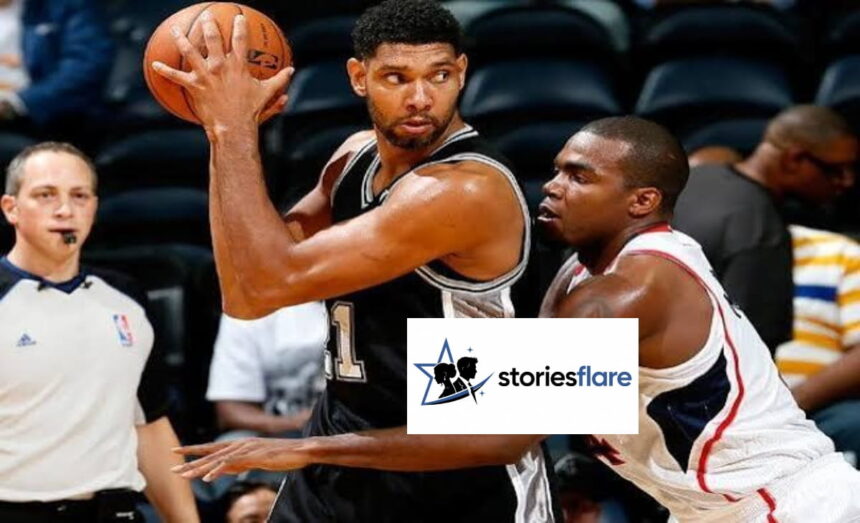
Some athletes announce their greatness with flash and noise. Tim Duncan announced his with a bank shot, a footwork drill, and nineteen years of showing up.
Nicknamed “The Big Fundamental,” Duncan built one of the most decorated careers in NBA history. He never chased the spotlight. He never needed to. Instead, he became the defining player of one of the league’s greatest dynasties — the San Antonio Spurs.
This article traces his journey from a swimmer on a small Caribbean island to a five-time NBA champion and Hall of Famer. It examines the forces that shaped him, the records he set, and the legacy he continues to leave behind.
Early Life on St. Croix
Timothy Theodore Duncan was born on April 25, 1976, in Christiansted, on the island of St. Croix in the U.S. Virgin Islands. His father, William, worked as a mason. His mother, Ione, was a midwife. Tim was the youngest of three children and the only son in the family.
A Swimmer First
Basketball was not his first love. As a boy, Duncan was a talented competitive swimmer. His older sister Tricia represented the Virgin Islands at the 1988 Olympics as a swimmer. Tim had ambitions of following her into elite competition.
Those plans changed abruptly in 1989. Hurricane Hugo tore through St. Croix and destroyed the island’s only Olympic-sized swimming pool. With nowhere left to train, Duncan turned his attention to basketball.
Finding the Game Late
He was around 14 years old when he picked up the game seriously. His brother-in-law guided him early on. Height came quickly. Skill followed. However, Duncan attracted relatively little attention from major college recruiters despite his obvious physical tools. That fact seems almost unthinkable given what followed.
He played high school football at St. Dunstan’s Episcopal High School. His path to basketball stardom was not obvious from the outside. But the foundation was being built quietly — exactly the way Tim Duncan would always do things.
Wake Forest University: The Making of a Star
In 1993, Duncan enrolled at Wake Forest University in Winston-Salem, North Carolina. He chose academics and player development over an early jump to the professional ranks. He studied psychology — a detail that resurfaced later when he co-authored a chapter in an academic book on interpersonal behavior alongside his professor, Mark Leary.
Dominant on the Court
On the court, Duncan became one of the most dominant college players in the country. Over four years with the Demon Deacons, he helped the team post a 97–31 record. He finished as the program’s all-time leading shot-blocker with 481 career blocks — at the time the second-most in NCAA history. He also finished third on the ACC’s all-time rebounding list with 1,570 boards.
A Promise to His Mother
Duncan’s decision to stay all four years at Wake Forest carried deep personal meaning. By his junior year, scouts projected him as a potential number-one pick. He could have left early. He chose to stay.
His mother had died of cancer when he was a teenager. Before she passed, he had promised her he would finish his degree. He kept that promise. That decision spoke to the character that would define his entire professional career.
In his senior season, Duncan swept the major national player-of-the-year honors. He won the John R. Wooden Award, the Naismith College Player of the Year Award, and AP Player of the Year. He also earned First Team All-American honors for the second consecutive year.
Arrival in San Antonio: The 1997 NBA Draft
The San Antonio Spurs selected Duncan with the first overall pick in the 1997 NBA Draft. It proved to be one of the most consequential draft decisions in league history.
The Twin Towers
San Antonio paired Duncan with veteran center David Robinson. Together, they formed the famous “Twin Towers.” Two seven-footers with complementary skills and elite basketball IQ made the Spurs nearly impossible to match up against inside.
Duncan’s rookie season previewed everything to come. He averaged a double-double. He earned NBA Rookie of the Year honors. The Spurs advanced to the playoffs but fell in the second round. That setback was temporary.
The First Championship
The following year brought the lockout-shortened 1998–99 season. Duncan and Robinson led San Antonio to the franchise’s first NBA championship. They swept past the New York Knicks in the Finals. Duncan won Finals MVP. He became just the third player in league history — joining Magic Johnson and Kareem Abdul-Jabbar — to win the award in his first two professional seasons.
The Rise of a Dynasty
The early 2000s saw Duncan cement himself as the best player in basketball. He won back-to-back NBA MVP awards in 2002 and 2003. In 2003, he led the Spurs to their second championship. They defeated the New Jersey Nets in the Finals. Duncan captured his second Finals MVP award. That same year, Robinson retired and passed the torch fully to Duncan as the unquestioned franchise leader.
The Big Three Era
Duncan soon teamed up with two young guards — Tony Parker and Manu Ginóbili. The trio became known as the Spurs’ “Big Three.” Under head coach Gregg Popovich, the group won championships in 2005 and 2007. Duncan claimed another Finals MVP in 2005.
Together, Duncan, Parker, and Ginóbili set NBA records for the most wins by a trio in both the regular season and the postseason. Furthermore, their partnership became one of the most celebrated in basketball history.
The Duncan Style
Duncan’s game was built entirely on substance over style. He relied on a soft bank shot off the glass, textbook post footwork, disciplined defense, and an unusual calm under pressure. He was rarely the most explosive player on the floor, also he was almost always the most reliable.
Sustained Excellence Into a New Decade
Where many great players decline sharply with age, Duncan kept winning. San Antonio made the playoffs in every single one of his 19 seasons. The team posted a winning percentage of at least .600 in each of those 19 years. That stands as an all-time record across the four major U.S. professional sports leagues.
2013: Heartbreak in the Finals
In the 2012–13 season, at age 37, Duncan earned First Team All-NBA honors for the tenth time in his career. He led San Antonio back to the Finals. The Spurs fell in seven games to the Miami Heat in a heartbreaking series. Game 6 of that series remains one of the most discussed games in NBA history.
2014: Revenge and a Fifth Title
Rather than fade quietly, Duncan and the Spurs came back stronger. In 2014, at age 38, Duncan led San Antonio — now with a deeper supporting cast including Kawhi Leonard and Danny Green — to a Finals rematch against Miami. The Spurs dismantled the Heat in five games. Duncan won his fifth and final championship.
That 2014 title made Duncan the only player in NBA history to start for a championship team in three different decades. It served as an emphatic close to one of the greatest careers the sport has ever seen.
Retirement and Statistical Legacy
Duncan played his 19th and final season in 2015–16. He remained productive at age 40 as the Spurs won a franchise-record 67 games, also he officially retired that summer.
He spent his entire career with one franchise — a rarity in modern professional sports shared by only a handful of players such as John Stockton and Kobe Bryant.
The Numbers
The statistics Duncan left behind are staggering:
- 19.0 points per game across 1,392 regular-season games
- 10.8 rebounds per game
- 3.0 assists per game
- 2.2 blocks per game
- 26,496 career points — San Antonio’s all-time leader
- 15,091 career rebounds — San Antonio’s all-time leader
- First all-time in career NBA double-doubles
- First all-time in postseason double-doubles and blocks
The Trophy Case
- 5 NBA Championships
- 2 Regular-Season MVP Awards
- 3 Finals MVP Awards
- 15 NBA All-Star selections
- 15 All-NBA Team selections — tied for the most ever
- 15 All-Defensive Team selections — the most ever
- Named to an All-Defensive team in each of his first 13 seasons — an NBA record
Hall of Fame and NBA 75
In 2020, Duncan entered the Naismith Memorial Basketball Hall of Fame in his first year of eligibility. In 2021, the NBA named him to its 75th Anniversary Team — an honor reserved for the 75 greatest players in league history.
Coaching and Life After Playing
Duncan did not disappear from basketball after retiring as a player. He joined Gregg Popovich’s coaching staff with the Spurs as an assistant coach. He passed along the same fundamentals and quiet professionalism that defined his playing days to a new generation of San Antonio players.
Off the court, Duncan has long been active in philanthropy. During his playing career, he supported charitable causes centered on health awareness, youth programs, and education. This reflected a broader ethos within the Spurs organization that consistently prized substance and community contribution over celebrity.
Why Tim Duncan Matters
It is worth asking why a player often described as “boring” by casual observers earns such deep reverence from those who understand the game.
Duncan never sought highlight-reel fame. He did not trash-talk. He rarely celebrated dramatically, also he simply let his performance speak for itself — night after night, for nearly two decades.
That steadiness made him almost impossible to guard. It also made him essential to San Antonio’s identity as a franchise.
Most basketball analysts consider him the greatest power forward in NBA history. He faces competition from players like Karl Malone and Dirk Nowitzki. However, Duncan’s case rests on an unmatched combination of team success, individual accolades, and two-way dominance. Very few players in any sport have managed to serve as both an elite offensive weapon and a defensive anchor for as long as Duncan did.
Conclusion: The Fundamentals Built a Legend
Tim Duncan’s story is ultimately a story about doing the basics better than everyone else — for longer than everyone else.
From a hurricane-interrupted swimming career on St. Croix to five championship banners hanging in San Antonio, his path was defined by patience, discipline, and a stubborn resistance to hype. He never needed the spotlight. He never chased fame.
The résumé — five titles, two MVPs, three Finals MVPs, a Hall of Fame plaque, and a permanent place among the 75 greatest players ever — speaks for itself. In exactly the understated way Tim Duncan always did everything.
You might also find this related article interesting: Deja Jackson: The Ivy League Athlete and Private Daughter of Ice Cube Who Chose Purpose Over Fame
Frequently Asked Questions
How many NBA championships did Tim Duncan win?
Tim Duncan won five NBA championships — in 1999, 2003, 2005, 2007, and 2014. All five came with the San Antonio Spurs. He also won three Finals MVP awards, in 1999, 2003, and 2005, making him one of the most decorated players in Finals history.
Why is Tim Duncan called “The Big Fundamental”?
Tim Duncan earned the nickname “The Big Fundamental” because his game was built entirely on textbook basketball fundamentals. He relied on a classic bank shot, disciplined post footwork, sound defensive positioning, and consistent execution under pressure rather than athleticism or flashy plays.
Did Tim Duncan play any sport before basketball?
Yes. Before basketball, Tim Duncan was a competitive swimmer. His older sister Tricia represented the U.S. Virgin Islands at the 1988 Olympics as a swimmer. Duncan had ambitions of following her into elite competition. However, Hurricane Hugo destroyed St. Croix’s only Olympic-sized pool in 1989, which led him to switch to basketball at around age 14.
What records does Tim Duncan hold in the NBA?
Tim Duncan holds several all-time NBA records. These include the most career double-doubles in regular season history, the most postseason double-doubles, the most postseason blocks, the most All-NBA Team selections tied at 15, and the most All-Defensive Team selections at 15. He also holds the record for earning both All-NBA and All-Defensive honors in the same season 15 times.
What is Tim Duncan doing in 2026?
As of 2026, Tim Duncan remains connected to the San Antonio Spurs organization as an assistant coach. He joined Gregg Popovich’s coaching staff after retiring as a player in 2016. He continues to pass on the fundamentals and professional discipline that defined his playing career to the next generation of Spurs players.